
Matters.AI Raises About US$12M to Scale Its "AI Security Engineer"
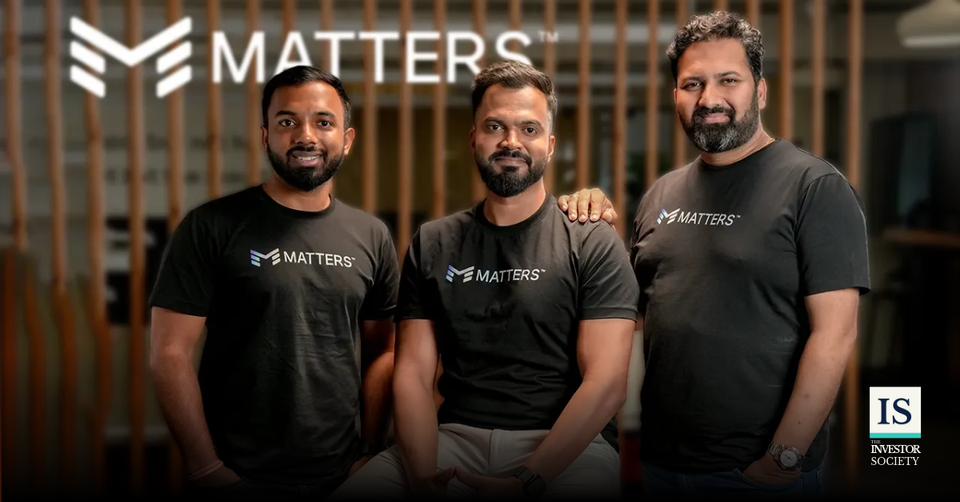
Matters.AI, a Bengaluru-based enterprise data security startup, has raised ₹115 crore (about US$12 million) in a pre-Series A round. Tanglin Venture Partners led the round, joined by IIFL Fintech Fund, Piper Serica, Bharat Tech Fund, Foster Ventures and Tetration Ventures, along with existing investors Kalaari Capital and Endiya Partners. The round, announced November 23, brings total funding to about ₹175 crore (US$18.25 million). The company is led by co-founder and CEO Keshava Murthy and co-founder and CTO Harsh Sahu. It previously operated as OptiQ.AI.
The platform is designed to show security teams where sensitive data lives and how it is used. It tracks where data sits, where it has traveled, who or what accessed it, and whether that use was intended, following data across cloud, on-premises systems, SaaS applications, endpoints and browsers. Matters.AI says it is deployed at more than 50 organizations, including major financial institutions, stockbroking and asset management firms, large retailers, and digital media platforms. The funds will go to R&D in data lineage, autonomous investigation, endpoint and browser intelligence, and preventing misuse of sensitive data by AI agents, as well as building a North American sales organization starting with senior leadership hires.
Market Context
The round extends a steady funding climb. Matters.AI raised ₹55 crore (US$6.2 million) in a seed round co-led by Kalaari Capital and Endiya Partners in October 2025, positioning itself in a category that combines data security posture management (DSPM), insider risk, data detection and response, exfiltration defense, and data loss prevention (DLP) in one layer. Consolidating those tools into a single platform has become the dominant strategy in the segment.
The category leader shows how much capital the space is drawing. Cyera's valuation has quadrupled since late 2024, rising from US$3 billion to US$12 billion, and in September it raised another US$400 million from Goldman Sachs Alternatives at an unchanged US$12 billion valuation, its third round of 2026. Cyera also announced the US$1 billion acquisition of agentic access management provider Oasis Security in July. Investor interest in DSPM has grown as breaches increasingly trace back to data companies did not know they had. Against that backdrop, Matters.AI is a small, early-stage challenger competing on cost and on its agent-focused positioning.
What Stands Out
"Security teams do not need another tool telling them something might be wrong."
— Keshava Murthy, co-founder and CEO, Matters.AI
Regional Relevance
For the United States, the round is explicitly aimed at the U.S. market, with proceeds funding a North American sales team. For U.S. enterprises, it adds another vendor to a crowded data security field where buyers are under pressure to control how AI agents access sensitive information. India-built security software often competes on engineering cost, which can translate into aggressive pricing against well-funded incumbents. The question for U.S. buyers will be whether a smaller vendor can meet the integration and compliance demands of large regulated firms.
The Other Side
Can a US$18 million company compete with a US$12 billion incumbent? Cyera, Palo Alto Networks, Zscaler and others are bundling data security into broad platforms with large sales teams. Matters.AI's counterargument is its focus on autonomous investigation and AI-agent risk, plus a customer base already running it in production. Breaking into North America, however, typically requires far more capital than a pre-Series A provides.
Is "AI security engineer" a product or a label? Many vendors now describe their tools as autonomous agents. Buyers will judge Matters.AI on false-positive rates, speed of investigation, and whether it can act without disrupting workflows. A supporting point: Piper Serica's Abhay Agarwal noted that regulated enterprises already run the company's data tracing in production.
Will India's compliance deadline drive sustainable demand? The DPDP deadline could produce a near-term buying wave, but compliance spending often peaks and then flattens. Long-term growth will depend on whether customers see the platform as ongoing security infrastructure rather than a one-time compliance purchase.
Sources & Transparency
- FinSMEs — Matters.AI Raises Approx. $12M in Funding
- Business Standard — Data security startup Matters.AI raises ₹115 crore in pre-Series A round
- DealStreetAsia — India Digest: Tanglin backs Matters.AI; Ionic Wealth raises funding from parent
- Entrackr — Matters.AI raises Rs 55 Cr led by Kalaari and Endiya Partners