Skalar Raises Seed to Fund Startup Growth Without Equity or Fixed Debt

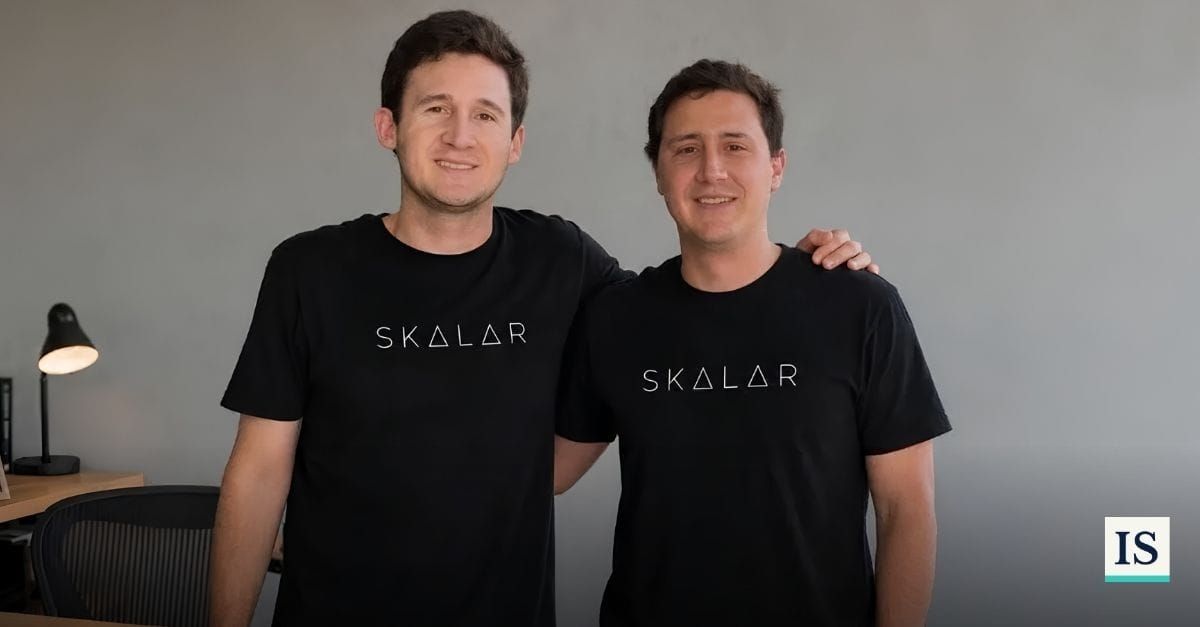
Skalar, a New York fintech founded in January 2026, came out of stealth on September 17, 2026 with a seed round led by Brazilian firm Monashees and a debt partnership with General Catalyst's Customer Value Fund. Nido Ventures and a group of angel investors also took part. Neither the seed amount nor the size of the General Catalyst facility was disclosed. What the company did disclose is the commitment on the other side of the balance sheet: more than US$125 million in sales and marketing spending it has agreed to finance for seven companies over the next 12 months.
The company was co-founded by Sebastián Cárdenas, who serves as chief executive, and Daniel Castrillón, chief operating officer. The two are childhood friends from Medellín, Colombia. Cárdenas studied engineering at Stanford, spent four years at Goldman Sachs and three at Monashees; Castrillón advised private equity funds at Bain & Company before joining Revolut. Skalar pays a client's customer acquisition costs directly and recovers roughly 1.1x that amount out of the revenue those specific customers generate, with no equity, no fixed repayment date and no lien on assets. Repayment accelerates if the client misses minimum revenue thresholds. The target profile is software companies spending between US$100,000 and US$3 million a month on acquisition, and the firm says it will work with no more than 15 of them a year. Headcount currently stands at five, including two data engineers.
Market Context
The underlying idea is that customer acquisition spending behaves like an asset rather than an expense. A software company that pays US$10 to win a customer worth US$1 a month is funding a receivable with a predictable payback curve, but accounting treats it as marketing, banks will not lend against it, and venture capital charges equity for it. Venture debt sits in between and comes with covenants, warrants and amortization schedules that do not follow the revenue. General Catalyst built its Customer Value Fund around exactly this gap in the United States, where the model's most cited example is the roughly US$1 billion in non-dilutive capital extended to Grammarly. Skalar's role is closer to a regional originator: it underwrites the deals, holds the client relationship and deploys capital that General Catalyst supplies.
The economics are tight and the risk sits with Skalar. A 1.1x recovery is only attractive if payback periods stay short, and the firm absorbs the cost if cohorts churn faster than modeled. That is why it is capping itself at 15 clients a year and staffing data engineers before salespeople. The demand side is less ambiguous. Venture capital in Latin America remains far below its 2021 peak, the regional venture debt market is thin, and local banks rarely lend against intangible assets. Four or five of Skalar's first seven clients are Latin American; the rest operate in the United States.
The Signal
"Venture capital solved the problem of funding the top 1% of tech businesses. But 99% of tech businesses just don't have access to capital today." — Sebastián Cárdenas, Co-Founder and CEO, Skalar
Regional Relevance
For the United States, Skalar is a test of whether a financing structure invented inside one of the country's largest venture firms can be unbundled and resold by a five-person company. General Catalyst's Customer Value Fund has been available almost exclusively to its own portfolio and to companies at Grammarly's scale. If a specialist originator can underwrite the same risk for mid-sized software businesses, the addressable market widens considerably, and so does the competitive pressure on venture debt providers who have spent the past two years repricing after the collapse of Silicon Valley Bank. American software companies spending seven figures a month on acquisition now have a third option that does not touch the cap table or the covenant package.
For Latin America, the significance is about which growth gets funded. Regional startups have historically been forced to choose between raising equity at valuations set in a weak market or slowing customer acquisition to protect runway. A facility that pays the marketing bill and collects from the customers it produces effectively separates growth financing from company financing. It also puts a US-domiciled underwriter between global debt capital and Latin American operators, which is the same intermediation role that regional fintechs built in payments and payroll lending.
The counterweight is concentration. Seven clients, a 15-per-year ceiling and five employees mean a single cohort underperforming can move the whole book. Skalar is pricing a risk that is well understood in theory and rarely tested through a downturn in the region where it is most concentrated.
The Other Side
Is 1.1x enough to cover the loss rate? The spread looks thin for unsecured exposure to early-growth software companies with no collateral behind it. It works if payback periods run six to nine months and defaults stay rare, and it stops working quickly if a client's cohorts decay or the company itself fails before the customers pay back. The structure has no lien to fall back on, which is the feature clients are buying and the risk Skalar is holding.
Does the model reward the wrong customers? A company willing to hand over a share of future customer revenue rather than raise equity may be doing so because equity is expensive for good reasons. Adverse selection is the standing objection to every non-dilutive financing product, and Skalar's answer is underwriting discipline and a hard cap on volume, which is a constraint on growth as much as a control.
What happens if General Catalyst does this directly? Skalar's capital comes from the firm that pioneered the structure. Today Skalar supplies origination and underwriting in a region General Catalyst does not cover closely. If the market proves out, the obvious question is whether the capital provider needs the intermediary, or whether it acquires one.
Sources & Transparency
- Exclusive: Fintech Offers Startups Alternative To Venture Debt With A New Model To Finance Customer Acquisition Costs
- Skalar ya comprometió US$125 millones para financiar el crecimiento de startups
- Skalar, fintech para CAC, sale del modo oculto con US$125M
- Skalar: fintech que financia CAC sin deuda fija ni equity