Cashea raises $100M to boost Venezuela’s Consumer Economy
A Venezuelan fintech pulling in nine figures matters because it proves credit demand survives even when the entire formal banking system does not.

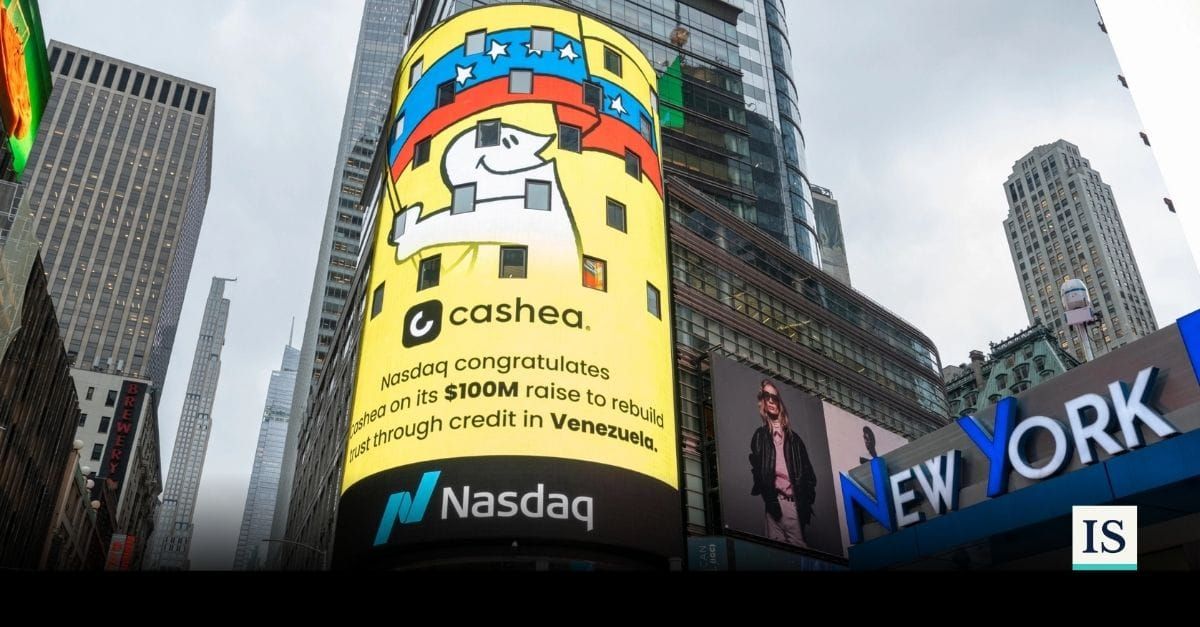
Cashea, a buy-now-pay-later platform founded in Caracas in 2022 by Pedro Vallenilla, just raised US$100M across two rounds inside one of the world's most distressed economies. The capital arrived in two tranches: a US$40M Series A closed in March 2026, with Architect Capital providing financing and Spice Expeditions leading, followed by a US$60M Series B closed in June 2026, led by FinSight Ventures with participation from Endeavor Catalyst and a group of Latin American venture firms. For investors and operators, the hook is simple: global capital just wrote nine-figure checks into a market most funds had written off entirely.
What makes the deal notable is not the headline number but the traction behind it. Cashea reaches roughly 35% of Venezuelan adults, processes more than one transaction per second, and now claims transaction volume exceeding 3% of Venezuela's GDP. It reached that scale in a country where hyperinflation gutted the banking sector, credit cards vanished, and formal lending effectively stopped. The Series B lead, FinSight Ventures, did not back a speculative bet on a frontier market; it backed a company that already runs at national scale with a non-performing loan rate below 2%. That combination of distressed geography and disciplined credit performance is where the real lessons sit.
What Cashea actually does
Cashea lets Venezuelans buy goods in interest-free installments through an app that connects buyers directly to local merchants. The model inverts the usual credit chain. Merchants on the platform extend credit to their own customers, and Cashea sits underneath as the infrastructure layer, providing insurance against defaults on the back end. The customer pays over time, the merchant gets paid, and Cashea collects a fee. No interest touches the buyer, and no bank is required by any party in the transaction.
The mechanism behind the numbers
The differentiation is that Cashea did not try to rebuild Venezuela's collapsed banking rails. It routed around them. Years of hyperinflation wiped out formal credit, so Cashea built a closed loop where merchant relationships and default insurance replace the underwriting and balance sheets banks used to provide. That structure explains both the reach and the risk profile: 3,500-plus merchants across more than 25 cities feed transaction data and distribution, while the sub-2% non-performing loan rate signals the credit discipline holding the whole system together. The fee-on-volume model, rather than interest income, is what let the company scale to a third of the adult population without triggering the affordability backlash that has dogged BNPL elsewhere.
Market context
Cashea's raise lands in the middle of a global BNPL reckoning. Across 2025 and 2026, regulators in the US, UK, and EU tightened rules on installment lending, pushing affordability checks and credit reporting onto players like Klarna and Affirm, whose valuations swung hard through the cycle. Venezuela sits outside that regulatory tightening, which cuts both ways: less compliance drag, but also thinner legal infrastructure and heavier country risk. Against that backdrop, the presence of Endeavor Catalyst and a syndicate of Latin American funds signals that regional capital increasingly views frontier fintech as an infrastructure play rather than a lottery ticket. The comparison worth holding is that Cashea reaches 35% of its adult market, a penetration rate mature BNPL firms in wealthy economies rarely approach, precisely because it filled a total vacuum rather than competing for share in a crowded credit landscape.
What this means for investors and business owners
- A vacuum beats a crowded market. Cashea scaled fast because there was nothing to displace. When formal credit collapses, whoever rebuilds the rails captures the entire category, not a slice of it. For founders and investors, the lesson is that the most defensible positions often sit in markets everyone else has abandoned, where the competitive field is empty and demand is structurally trapped.
- Distribution can be borrowed, not built. Rather than underwriting millions of individual consumers directly, Cashea pushed credit issuance to its 3,500 merchants and inserted itself as the insurance and settlement layer. Offloading the hardest, most capital-intensive part of a business to existing partners is a repeatable pattern: find who already has the relationships, then become the infrastructure they cannot operate without.
- Credit quality is the whole story. A sub-2% non-performing loan rate in a hyperinflationary economy is what turned Cashea from a risky bet into a fundable company. Growth without credit discipline is how lenders die. The metric that convinced a US$60M Series B lead was not user count; it was the proof that the loan book actually performs.
- Frontier risk can be a moat. The same country conditions that scare off most capital, currency instability and weak legal recourse, also keep competitors out. If you can build durable operations inside that difficulty, the barrier that repelled everyone else becomes your protection. Investors should treat operational competence in hard geographies as a rare and priceable edge.
- Fee models scale where interest models stall. By charging merchants a fee rather than charging consumers interest, Cashea sidestepped the affordability and regulatory backlash crushing BNPL margins elsewhere. Aligning your revenue with the party who can most afford to pay, and who benefits most from the transaction, is often more durable than extracting it from the most vulnerable side of the market.