
Etched's Valuation Doubles to $21B in a Month After a $700M Round Led by Jane Street
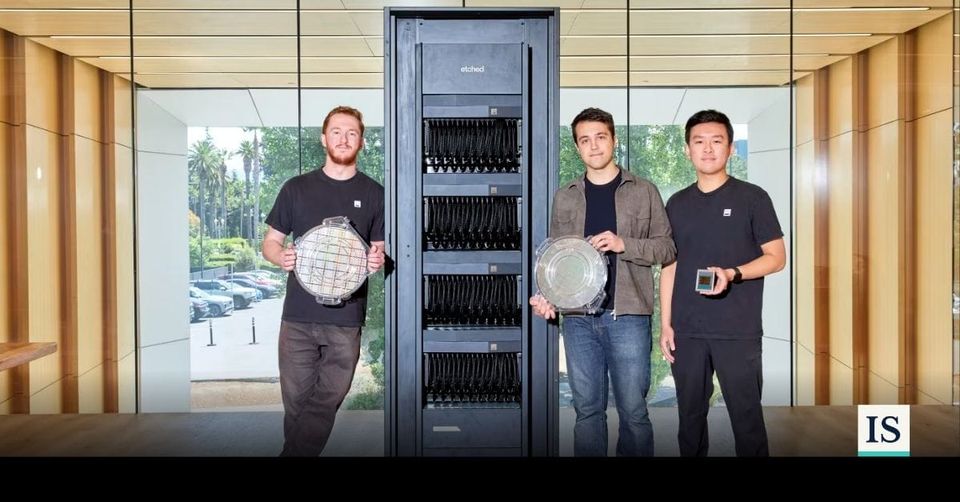
Etched has raised US$700 million at a US$21 billion valuation in a round led by the quantitative trading firm Jane Street, roughly doubling the US$10.3 billion valuation it carried in July 2026 and quadrupling the US$5 billion it was assigned in December 2025. Existing backers Kleiner Perkins, Sequoia Capital, Andreessen Horowitz, Peter Thiel, Tiger Global, Bain Capital Ventures, Blackstone, Stripes, Primary Venture Partners, Positive Sum Ventures, Neo, Diffusion, and Argo also participated. The company has now raised close to US$2 billion since its founding.
Etched was founded in 2022 by Gavin Uberti, Chris Zhu, and Robert Wachen, three Harvard students who left to build the company and became one of the first teams collectively awarded a Thiel Fellowship; Wachen serves as chief operating officer. Operating from San Jose, the company builds Sohu, a chip fabricated on TSMC's 4-nanometer process that hard-wires the matrix multiplication patterns used in transformer inference and omits hardware for any other neural network architecture. Etched claims an eight-chip Sohu server produces more than 500,000 tokens per second on Llama-70B against roughly 23,000 for an eight-GPU Nvidia H100 system, and Uberti has said one Sohu server replaces 160 H100s. The latest round funds two additions: a prefill chip running at low voltage to process more tokens faster, and what the company calls cluster-scale memory. "It allows many chips to connect together and use a shared memory pool at a very, very fast, low latency," Wachen said. Jane Street installed and approved the first shipped system before leading the round, and Etched reports more than US$1 billion in bookings.
Market Context
The company's central bet is a narrowing one. Sohu can only run transformer models, the architecture behind current large language systems, which is what allows the performance claims but also removes the flexibility that has made general-purpose GPUs the default. That trade-off is the entire investment thesis: if transformers remain dominant, a chip built exclusively for them is dramatically more efficient; if the field moves to a different architecture, the hardware does not adapt.
Etched has also been recruiting directly from the incumbent. Roughly 15% of its approximately 400 employees previously worked at Nvidia, including systems engineer Brian Loiler, who spent 23 years there and subsequently brought in about a dozen more Nvidia engineers, some of whom declined counteroffers. Nvidia's defenses remain substantial: the CUDA software ecosystem, networking stack, developer tooling, and long-standing data center relationships are not replicated by a faster chip. Etched still has to demonstrate manufacturing reliability and supply security at volume, and one indicator of its engineering pace is that it ran inference workloads 44 days after receiving test chips from TSMC, a step that typically takes months.
The Number
Four times in eight months. Etched was valued at US$5 billion in December 2025, US$10.3 billion in July 2026, and US$21 billion in August, with the most recent doubling occurring in roughly four weeks.
Regional Relevance
For the United States: Etched operates from San Jose and is attempting something American venture capital has funded repeatedly without success, which is a credible domestic challenge to Nvidia in AI silicon. The migration of experienced Nvidia engineers to a startup is a signal about where technical talent believes the next architecture is being built, and the participation of Blackstone and Jane Street alongside traditional venture firms shows how far institutional capital has moved into private semiconductor bets. Because Sohu is manufactured by TSMC, the company also inherits the same Taiwan supply chain concentration that US policy has spent years trying to reduce.
For the global AI infrastructure market: Inference, the computation that happens each time a user submits a prompt, is becoming the larger share of AI compute spending as deployment outpaces training. Specialized inference silicon is being pursued worldwide, and a company demonstrating that a fixed-function chip can outperform general-purpose GPUs at scale would change procurement decisions for data center operators far outside the United States. It would also increase pressure on the cost of running AI services, which currently constrains adoption in markets where compute is priced in dollars but revenue is not.
The Other Side
What happens if the architecture changes? Sohu is physically incapable of running anything other than transformers. That is the source of its efficiency and its single largest risk, since a shift in model architecture would render the hardware obsolete rather than merely slower, and the field has moved before. Investors at US$21 billion are underwriting the assumption that transformers dominate for years.
Is one customer enough validation for a quadrupled valuation? Jane Street installed the first system and then led the round, which means the company's most prominent customer reference and its lead investor are the same firm. More than US$1 billion in bookings is meaningful, but bookings are not deliveries, and Etched has not disclosed revenue, delivery volumes, or how many distinct customers those orders represent.
Can a startup match Nvidia's ecosystem rather than its silicon? The comparison Etched publishes is tokens per second, where its advantage is largest. Data center buyers evaluate software maturity, networking, support, roadmap continuity, and supply guarantees, areas where Nvidia has spent nearly two decades building position. Hiring its engineers accelerates the hardware but does not transfer CUDA, and the performance figures the company cites remain company-reported and untested by independent benchmarks at scale.
Sources & Transparency
- TechCrunch — Etched's valuation doubles to $21B in a month
- Tech Startups — $21 billion AI chip startup Etched takes on Nvidia, poaches its engineers and lands Jane Street
- TechCrunch — AI chip startup Etched defies skeptics, hits $10.3B valuation from big-name investors
- Startup Fortune — Etched raises $300M at a $10.3B valuation on a bet that transformer-only chips will displace Nvidia at the inference layer
- Tech Funding News — Harvard dropouts' Etched raises $500M at $5B valuation to challenge Nvidia