
Ranchbot Raises $15 Million Series B to Accelerate US and Global Growth
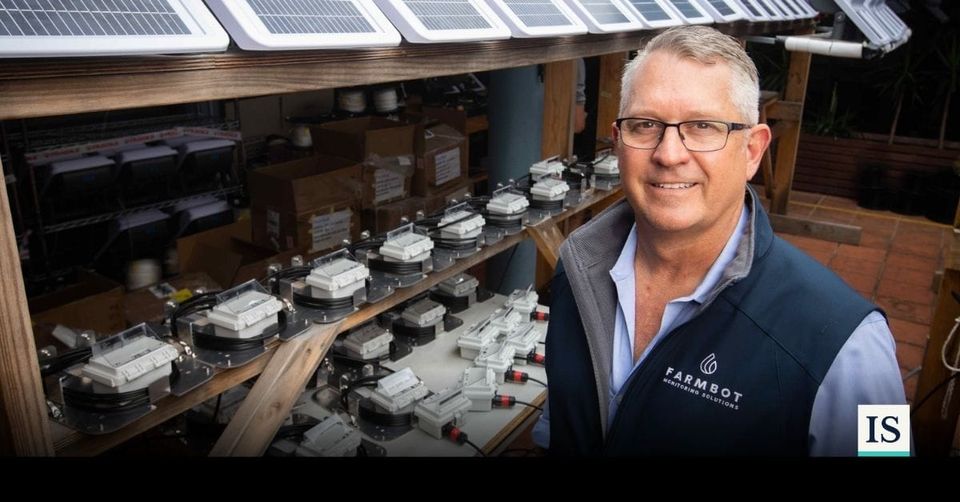
Ranchbot has raised US$15 million, roughly A$22 million, in a Series B round led by Lewis & Clark Partners, with participation from Fulcrum Global Capital, Builders VC, The Cultiv8 Livestock Technology Fund, Lever VC, and Macdoch Ventures. The company, founded in Sydney in 2014 and known as Farmbot in Australia, has established a Delaware parent company, Ranchbot Technology Holdings Inc., headquartered in Fort Worth, Texas.
Ranchbot sells satellite-connected sensors that monitor water infrastructure on ranches, tracking tank levels, pipelines, and troughs, and sending real-time alerts for leaks and low water without requiring cellular coverage. The business model pairs hardware with recurring software subscriptions; entry-level devices start around US$600, higher-tier units reach roughly US$1,600, and communication costs average about US$1 a day. The company serves more than 12,000 customers managing approximately 10 million cattle and 15 million sheep across Australia, North America, and other markets, and reports that customers cut fuel and vehicle maintenance costs by up to 30% by replacing manual water checks with a phone dashboard. CEO and Co-founder Andrew Coppin described the underlying problem simply: "Ask them how much water they've got and they'll answer enough or not enough." The company has grown from two co-founders to about 100 employees, roughly 30 in the United States, and plans to double its US workforce. Funds will go toward next-generation satellite devices, remote pump controls, smart trough monitors, rain gauges, flow meters, and tools for tracking soil health and pasture quality.
Market Context
The timing aligns with severe conditions across American cattle country. Roughly 72% of the US cattle herd sits in drought-affected areas, with 48% in severe drought, concentrated across Nebraska, Colorado, Wyoming, southern Montana, and western Kansas, according to the National Drought Mitigation Center and US Drought Monitor. Forage supplies are expected to stay tight, and producers face the prospect of a difficult winter with limited feed. Lewis & Clark Partners' Chuck Warta framed the investment thesis around that gap: "Water is one of the most critical inputs in cattle production, yet managing water infrastructure remains highly manual."
Texas, where the company has planted its US headquarters, has its own water pressures from population growth and drought across South and West Texas, and lawmakers have approved a historic US$20 billion infrastructure package alongside work on an updated 50-year water security plan. Coppin has said Fort Worth was chosen for its accessibility to ranches spanning Montana to Florida and its proximity to Texas universities training the next generation of ranchers. The broader operating environment, tight margins, labor shortages, and rising fuel costs, is what makes automation of routine ranch tasks commercially viable.
The Signal
"Ask them how much water they've got and they'll answer enough or not enough." — Andrew Coppin, co-founder and executive chairman, Ranchbot
Regional Relevance
For the United States: Ranchbot's decision to establish a Delaware holding company and move its headquarters to Fort Worth marks a full commercial pivot toward the American market, where cattle operations are larger and more capital-intensive than in Australia. That matters at a moment when drought is constraining herd rebuilding and record retail beef prices are drawing attention to production costs. Texas is both the largest cattle-producing state and a market where water scarcity has become a legislative priority, making it a logical base, and the company's plan to double US headcount adds to a growing agricultural technology cluster around Fort Worth.
For Australia and global livestock producers: Ranchbot began as Farmbot serving Australian graziers, an environment defined by vast properties, unreliable connectivity, and recurring drought, which is precisely the set of constraints that produced the product. The company's move of corporate headquarters to the United States follows a pattern familiar to Australian technology firms that scale into the larger American market, and raises the question of where future engineering and value creation will sit. For livestock producers in Latin America, Africa, and other regions with extensive grazing systems and limited rural connectivity, satellite-based monitoring that works without cell coverage is directly relevant, though pricing at US$600 to US$1,600 per unit plus daily communication fees is a meaningful barrier outside wealthier markets.
The Other Side
Can ranchers afford the hardware in a drought year? Devices cost between US$600 and US$1,600 each, and a large operation needs many of them, plus roughly US$365 a year per unit in communication costs. The 30% fuel savings the company cites are real for operations doing daily water runs, but drought years are precisely when capital spending gets deferred, and the customers with the most acute need may be the least able to buy.
Are the reported savings independently verified? Figures on fuel and maintenance reduction and the scale of cattle and sheep under management come from the company, and no third-party study or audited customer data has been published; buyers in agriculture typically discount vendor-reported return figures until they see results on comparable operations in their own region.
Does the product roadmap risk overextension? The stated plan spans next-generation satellite hardware, remote pump controls, smart trough monitors, rain gauges, flow meters, and soil and pasture monitoring, which is a wide set of engineering commitments for a US$15 million round at a company of roughly 100 people that is simultaneously relocating headquarters and doubling its US team.
Sources & Transparency
- citybiz — Ranchbot Raises $15 Million Series B to Accelerate U.S. and Global Growth
- Drovers — Ranchbot Raises $15M to Expand Satellite Water Monitoring for Cattle Operations
- Government Technology — Ranchbot to Help Texans Monitor Water Amid Scarcity Concerns
- Brownfield Ag News — Drought impacting nearly three-quarters of U.S. cattle herd
- Fort Worth Report — Made in Tarrant: Ranchbot corrals ranchers with remote water management technology
- Ranchbot — Remote Water Tank Monitoring Solutions