
Samsung Bets US$100M on Kairos to Power Google's AI With Molten Salt
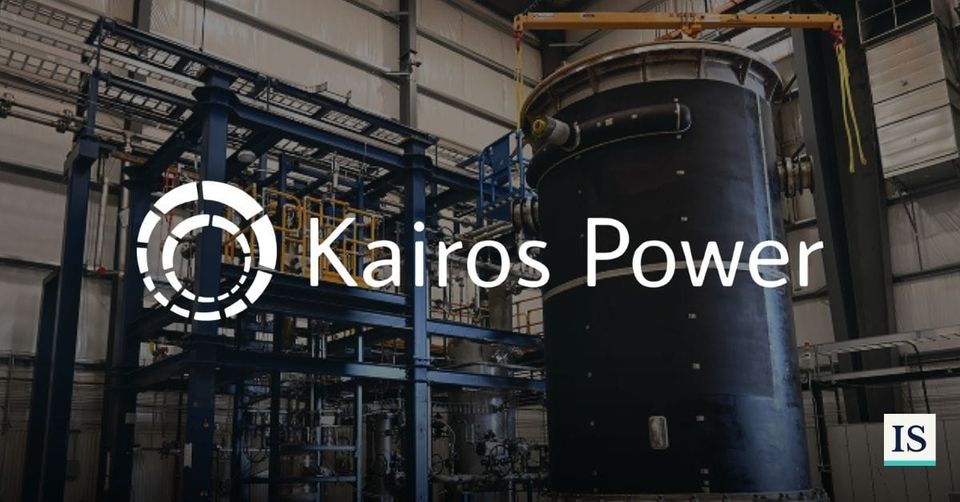
Samsung C&T, the construction and engineering arm of South Korea's Samsung Group, agreed to commit up to US$100 million to Kairos Power, the California-based advanced reactor developer building a nuclear plant that will supply Google. The package is split between roughly US$70 million in direct equity and the balance in engineering services, and remains subject to regulatory approval. Samsung C&T joins the integrated engineering, procurement and construction team for Hermes 2, Kairos Power's first commercial-scale plant, now under construction at the former Oak Ridge Gaseous Diffusion Plant site in Tennessee. The Korean firm takes on power-generation systems and balance-of-plant work while Kairos Power, led by co-founder and Chief Executive Officer Mike Laufer, keeps the reactor technology and the nuclear island.
Hermes 2 is designed to deliver up to 50 megawatts of electricity into the Tennessee Valley Authority grid by 2030, under the first binding power purchase agreement between a US utility and an advanced reactor developer. It is the opening piece of a master agreement Google and Kairos Power signed in October 2024 for up to 500 megawatts of carbon-free capacity by 2035, sized to feed Google data centers in Tennessee and Alabama. The Nuclear Regulatory Commission cleared construction in late 2024, making Hermes 2 the first Generation IV reactor in the United States to receive a construction permit, and ground was broken in April 2026. As part of the deal, Samsung C&T secured priority rights on engineering and construction work for the commercial reactors Kairos Power plans to build next, and the two companies will jointly look at projects in South Korea, Southeast Asia and Europe.
Market Context
The reactor Kairos Power is building is not a scaled-down version of what utilities run today. The KP-FHR design is cooled by molten fluoride salt at near-atmospheric pressure and burns TRISO fuel, uranium kernels wrapped in ceramic and carbon layers and packed into pebbles, an approach meant to remove the high-pressure steam explosion and meltdown pathways that drive conventional plant costs. Both technologies trace back to research done at Oak Ridge decades ago, which is part of why the company anchored its construction hub there. The commercial version is expected to reach roughly 140 megawatts of electricity per unit, with the current 50-megawatt plant serving as the proof that the factory-built, modular delivery model works.
Public money got the program this far. The Department of Energy awarded Kairos Power US$303 million under the Advanced Reactor Demonstration Program, about 48% of the US$629 million cost of the Hermes test reactor, structured as fixed-price milestone payments rather than cost reimbursement, and the DOE has also committed to supply the high-assay low-enriched uranium fuel. What has changed since is who else is paying. Hyperscalers turned into the sector's anchor customers as AI power demand outran grid additions, with Microsoft contracting Three Mile Island's restart and Amazon backing X-energy on a similar bet. Samsung C&T's check is the next layer: an industrial builder taking equity in a supplier so it can secure the construction work. The firm has built or helped build around a dozen reactors worldwide and has been pivoting toward small modular reactors and data center power as Korean homebuilding slows.
The Number
Samsung C&T's investment and partnership "reinforce the disciplined delivery model at the core of our commercialisation strategy." — Mike Laufer, Chief Executive Officer and co-founder, Kairos Power
Regional Relevance
For the United States, the signal is that the advanced nuclear industry has found a second source of capital beyond Washington and Silicon Valley. The Hermes program was built on a federal cost-share; the offtake came from Google; the construction capability is now being bought with equity from a Korean engineering group with a global reactor résumé. That is a supply chain assembling itself in real time, and it matters because the binding constraint on American nuclear is no longer permitting or technology risk alone but the shortage of firms that can actually build a reactor on schedule. Hermes 2 will be an early public test of whether a US-designed Gen IV plant can be delivered at a cost that survives contact with a utility rate base.
For Tennessee, the project turns a Cold War enrichment site into the country's first commercial-scale Gen IV construction yard, with a workforce being trained on the job and a reactor equipment plant in Albuquerque feeding it. The state gets the industrial base; TVA gets a template for procuring power it has never bought before.
For South Korea, the investment is an export strategy in miniature. Korean builders spent the last two years redirecting capital from a slumping domestic housing market toward nuclear, data centers and overseas infrastructure, and Samsung C&T has been signing SMR agreements on several fronts. Taking equity in an American developer with a signed hyperscaler contract buys a seat in the technology most likely to define the next generation of reactor exports, and the priority EPC rights are the real asset in the deal.
The Other Side
Does a construction partner fix the thing that actually kills nuclear projects? Not by itself. Vogtle and Flamanville had experienced builders too, and both ran years late on first-of-a-kind engineering rather than on labor supply. Samsung C&T's scope here is balance of plant, the part of the project that most resembles conventional power construction. The nuclear island, where schedule risk concentrates, stays with Kairos Power.
Is US$100 million meaningful against a project of this size? It is small next to the US$629 million Hermes test reactor alone, and Hermes 2 plus the 500-megawatt fleet implies capital requirements an order of magnitude larger. The strategic value is the delivery capability and the option on future work, not the cash. Investors should read it as validation from an industrial buyer, not as the round that funds the build-out.
What happens to the economics if AI power demand cools? Google's commitment runs to 2035 and the first 50 megawatts is contracted through TVA, so near-term revenue is insulated. The fleet math is not. The case for 500 megawatts of premium-priced carbon-free power assumes hyperscaler data center growth holds through the early 2030s, and if it slows, the reactors still get built at first-of-a-kind cost while the willingness to pay for them softens.
Sources & Transparency
- Kairos Power gets up to $100M from Samsung group to build nuclear reactor for Google
- Samsung C&T invests in Kairos Power
- Kairos Power Breaks Ground on Hermes 2 Demonstration Plant
- DOE, Kairos Unveil Milestone-Based Funding Agreement for Advanced Nuclear Demonstration Project
- Samsung C&T to invest up to $100m in Kairos Power partnership for next-gen SMRs
- Kairos Power selects Samsung C&T to help build 50MW SMR for Google in Tennessee