
Pilgrim Raises US$25M to Spread Its Airborne Pathogen Sensor Across the US
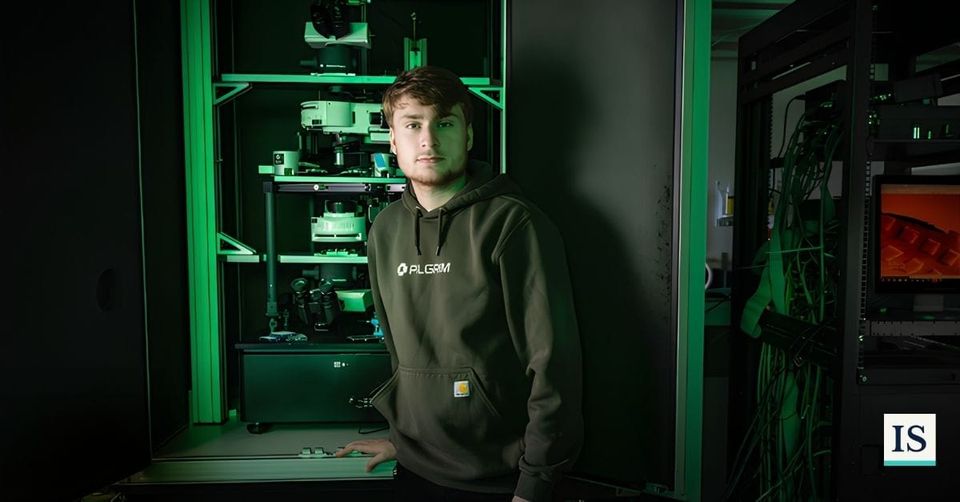
Pilgrim, a defense biotechnology startup based in Redwood City, California, raised a US$25 million seed round at a US$150 million valuation, the Wall Street Journal reported on September 23. Buckley Ventures led the round. Two senior Anthropic researchers invested personally: Logan Graham, who heads the AI company's Frontier Red Team, and Sholto Douglas, a member of its technical staff. Coinbase co-founder Fred Ehrsam also joined, alongside earlier backers that include Figma CEO Dylan Field. Pilgrim was founded by Chief Executive Officer Jake Adler, a 2023 Thiel Fellow who finished high school in 2022.
The money backs Argus, a 50-pound device that combines air sampling with genomic sequencing to detect airborne pathogens such as Ebola and anthrax. Pilgrim has a biosurveillance agreement with the U.S. Centers for Disease Control and Prevention, and units are already deployed around the country, according to the Journal. The company, which came out of stealth in 2025 with a US$4.3 million seed from Cantos VC, Thiel Capital, Day One Ventures and Refactor Capital, also develops Kingsfoil, a wound dressing that stops bleeding, and Voyager, an inhaled countermeasure for chemical threats.
Market Context
Pilgrim is entering a field where the federal government has openly said its tools are outdated. The Department of Homeland Security's BioWatch program, the main early warning system for airborne pathogens in U.S. cities, has been criticized for years, and DHS officials said this week that the current detection setup is "no longer suitable" for evolving threats. The agency is moving toward "agent-agnostic" detection that is not limited to a preset list of pathogens, and it opened a prize challenge in September for AI-assisted biodetection.
The appeal of pairing air sampling with sequencing is that it can, in principle, identify what is in the air rather than just flag known agents. That fits the direction DHS describes. Pilgrim's defense ambitions are still early, though: as of 2025 it had no active Defense Department contracts, but reported progress with the Defense Threat Reduction Agency, the Defense Health Agency and the Pentagon's chemical, biological, radiological and nuclear defense program office.
The Signal
"You can't have a force multiplier without the underlying force. If you can't stop the bleed, if you can't help that warfighter pick up their gun, then it doesn't matter." — Jake Adler, Founder and Chief Executive Officer, Pilgrim (to Axios, 2025)
Regional Relevance
For the United States, Pilgrim sits where AI safety and national security now meet. DHS officials have warned that AI is lowering the barrier to entry for building biological threats, and Graham's Frontier Red Team is the group at Anthropic that tests models for exactly that kind of misuse. Personal checks from researchers who study these risks every day signal that detection hardware is becoming part of the broader AI-era defense stack, not a niche public health tool.
For California and the Bay Area, Pilgrim adds to a growing cluster of Silicon Valley startups selling directly to defense and public health agencies, a market that once belonged almost entirely to large contractors. A young founder, a Thiel network and a CDC customer at the seed stage show how quickly the region's venture model is being applied to hard biodefense problems.
The Other Side
Is a US$150 million seed valuation justified by one agency deal? The CDC agreement is a strong signal, but its size, the number of units shipped and where they are installed have not been disclosed. Until those figures are public, investors are largely pricing the team and the market opportunity rather than proven revenue.
Can a startup break into government biodetection? BioWatch's replacement effort has dragged on for years, and federal procurement cycles are slow. Pilgrim will need repeat contracts across DHS, the CDC and the Pentagon, while larger defense and diagnostics companies compete for the same budgets.
Is Pilgrim spread too thin? Wound dressings, chemical countermeasures and pathogen sensors each come with their own regulatory path and buyers. Focus on Argus may be what this round rewards, but the broader portfolio could stretch a small team and a seed-stage balance sheet.
Sources & Transparency
- Anthropic Employees Back Pilgrim's $25 Million Funding Round
- Jake Adler's Pilgrim raises $25M to detect airborne biological threats
- Pilgrim raises $25M seed at $150M for airborne biothreat sensor
- This CEO wants to forge "a new generation of military medicine"
- DHS exploring new biosurveillance capabilities as biological threats evolve, officials say
- Pilgrim Raises $25M for Biothreat Tech