
Who Delivers Your Groceries Now?
Hi, and welcome to a new edition of The Daily Dealflow — the 5-minute briefing that gives you clear context on capital flows and market-moving trends across the Americas, from Silicon Valley to Buenos Aires. Let's dive in.
🏆 Deal of the Day
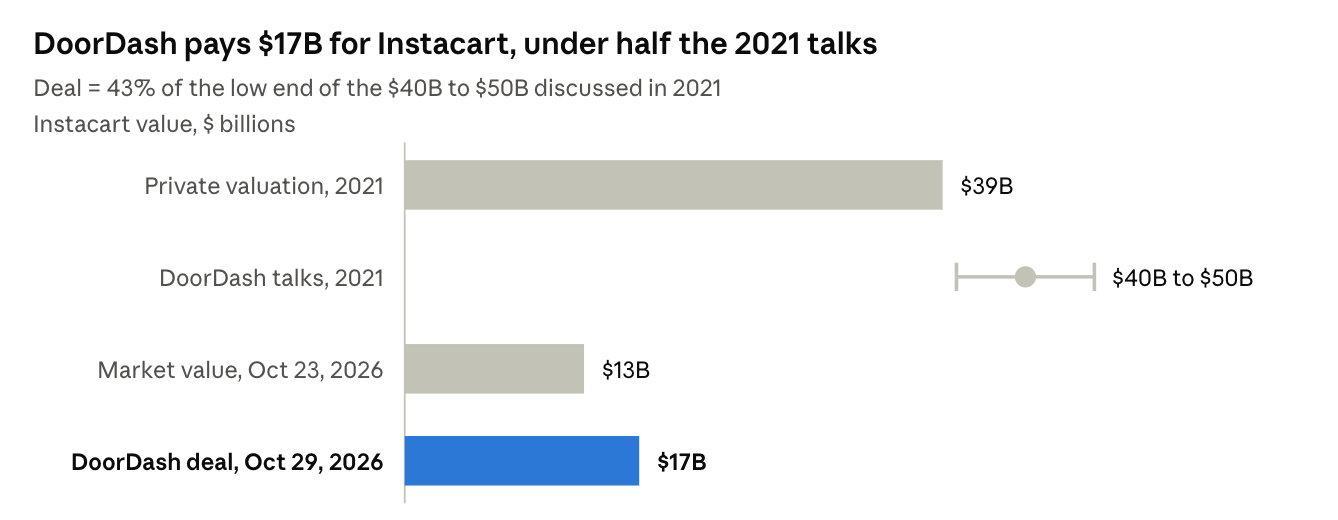
DoorDash agreed on Thursday to buy Instacart for $65 per share, an equity value of about $17B and a 26% premium to Instacart's October 22 close, the last trading day before deal reports surfaced. At least 75% of the price is cash, and Instacart holders can elect cash, DoorDash stock or a mix. DoorDash keeps the Instacart brand, app and enterprise software, with closing expected at the end of 2027 or in the first half of 2028.
Why This?: The deal joins the largest U.S. restaurant-delivery company with the largest grocery-delivery app, and it leaves Uber, whose talks with Instacart were no longer active per Reuters, on the outside. For founders across the Americas, it is a clear signal that delivery is a scale game, and that the winners would rather buy grocery know-how than build it.
Positive Context:
- DoorDash completed 993 million orders in the third quarter with almost $34B in customer spend, according to WHIO. Instacart customers would gain access to more than 50,000 extra stores on top of the nearly 100,000 already on the platform.
- DashPass and Instacart+ members would pay one fee instead of two, which the companies estimate saves members about $100M a year. The $65 price is more than double the $30 at which Instacart priced its 2023 IPO.
Yes, but:
- The deal needs Hart-Scott-Rodino clearance plus approvals in Canada and Israel, and the 2021 talks between the two companies ended over antitrust concerns.
- A closing window that runs into 2028 is long. Meanwhile, Instacart is winding down its Caper Cart smart-cart business and expects $55M to $80M in pre-tax charges.
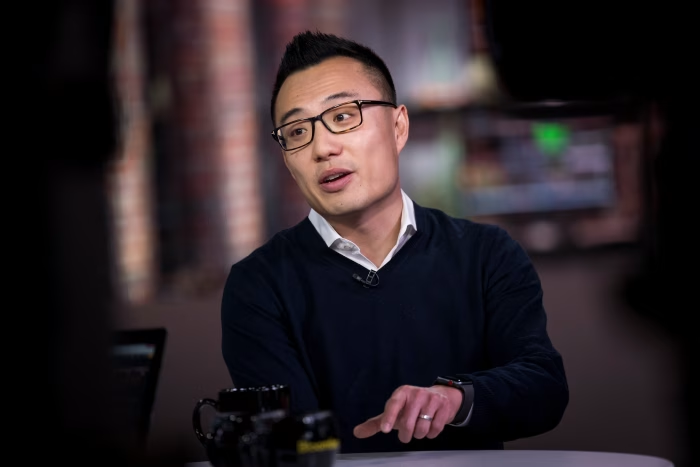
"Grocery is one of the hardest things to get right online," DoorDash co-founder and CEO Tony Xu said, according to TechCrunch.
💰 Venture Capital
Submit a deal for The Daily Dealflow newsletter via DM here on LinkedIn.
Upwind (US) – $400M, Series C at a $3.8B valuation, cloud security platform that watches applications while they run so teams can tell urgent threats from noise. Bessemer Venture Partners led, with Canapi Ventures plus returning backers Cyberstarts, Greylock, Craft Ventures, Salesforce Ventures and TCV. Founded by Amiram Shachar and co-founders, Upwind says revenue quadrupled this year, and its valuation jumped from $1.5B in about 9 months. The plot twist: the company reportedly walked away from an acquisition offer from Datadog before raising, per Segunda Base – Tech Startups.
Celes (Colombia) – $5M, Series A, AI agents and predictive models that forecast demand and plan daily replenishment for retailers, running more than 90% of those decisions on autopilot. Brazil's SP Ventures led, joined by Fulcrum Global Capital (US), 30N Ventures (Mexico) and Taram Capital (Chile). Celes already crunches 55 million forecasts a day across 8,500+ stores in eight countries for clients such as Olímpica, FEMSA Salud and Tiendas Neto. In 2024 seed was led by FEMSA Ventures, and this round pays for a formal landing in Brazil – Dealroom.
Kalshi (US) – $1B, Series G at a $40B valuation, CFTC-regulated prediction market where users trade contracts on elections, sports and other outcomes. Sequoia Capital and Wellington Management led, with Baillie Gifford, Morgan Stanley Investment Management, Coatue and Andreessen Horowitz. The price nearly doubles May's $22B mark and puts Kalshi ahead of rival Polymarket, last valued around $21B. On an IPO, co-founder and CEO Tarek Mansour would only say "there's been discussions," while dozens of state attorneys general keep arguing its sports contracts are gambling – Dealroom.
🏛️ Private Equity
Lightspeed Venture Partners (US) – $750M+, an AI buyout fund (the AI Renaissance Fund plus a co-investment vehicle) that beat its target. The fund will buy existing businesses and upgrade them with AI, a sharp turn for a firm known for early-stage bets. Partner Isaac Kim disclosed the numbers at a public meeting of New Mexico's sovereign wealth fund, and the total could reach $1B. Lightspeed is also moving its headquarters from Menlo Park to San Francisco – Dealroom.
Vela LatAm–GTI (Costa Rica) – undisclosed amount, acquisition of an e-invoicing and payments software company by Constellation Software's Latin American arm. It is Vela's first purchase outside Brazil this year and opens a fourth country. Following the Constellation playbook, GTI keeps its brand, founder Alejandro Montalvo and its management team. It is Vela's fourth tax-software buy of 2026: the company has turned Latin America's electronic invoice rules into an acquisition thesis – Startups.
EnerSys–Ultralife (US) – $320M enterprise value, all-cash tender offer at $16 per share, a 166% premium to Ultralife's October 26 close. Ultralife, based in Newark, New York, makes batteries for military communications and employs more than 700 people. EnerSys first sent its letter of interest in July, and part of its team used to work at Ultralife – SEC.
📈 Public & Capital Markets
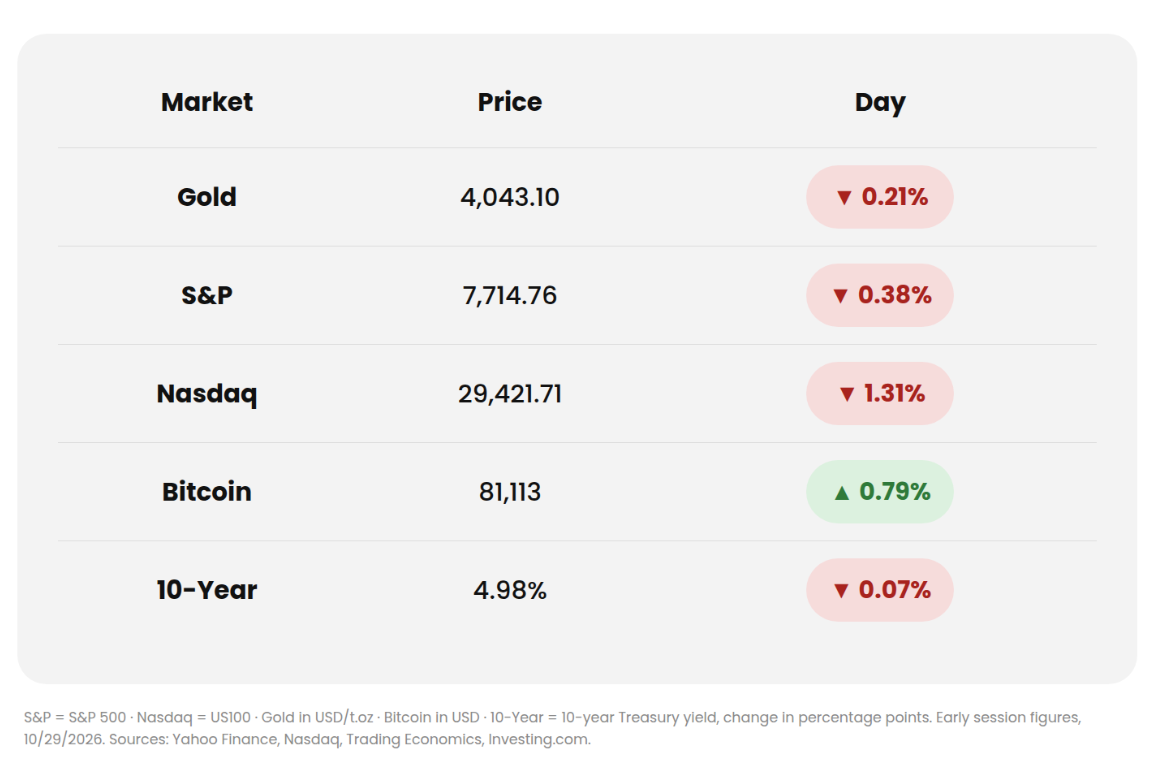
U.S. equities (NYSE, Nasdaq) – macro and market move. Stocks opened lower Thursday as Alphabet's earnings weighed on tech. In early trading the Nasdaq fell 1.2%, the S&P 500 0.3% and the Dow 0.1%. The economy gave some cover, with third-quarter GDP growing at a 3.4% pace – Yahoo Finance.
Marvell (Nasdaq) and Lumentum (Nasdaq) – reported M&A talks, AI optical networking. Bloomberg reports that Marvell is in advanced talks to buy Lumentum, which has a market value of about $83B; a deal could come as soon as next week. Marvell fell 9.3% after hours on the report, while Lumentum rose 13% to $1,040. Lumentum's CEO says key products are sold out through early 2029, and the deal would rank among the 10 largest tech and telecom deals ever – Dealroom.
Alphabet (Nasdaq) and Caterpillar (NYSE) – earnings reactions. Alphabet fell more than 9% after search revenue grew 12%, below the 15% Wall Street expected. That revived fears that AI chatbots are eating into search. Caterpillar, the 101-year-old maker of yellow machines, dropped about 8% before the open after its own report – Investrade.
📅 ICYMI
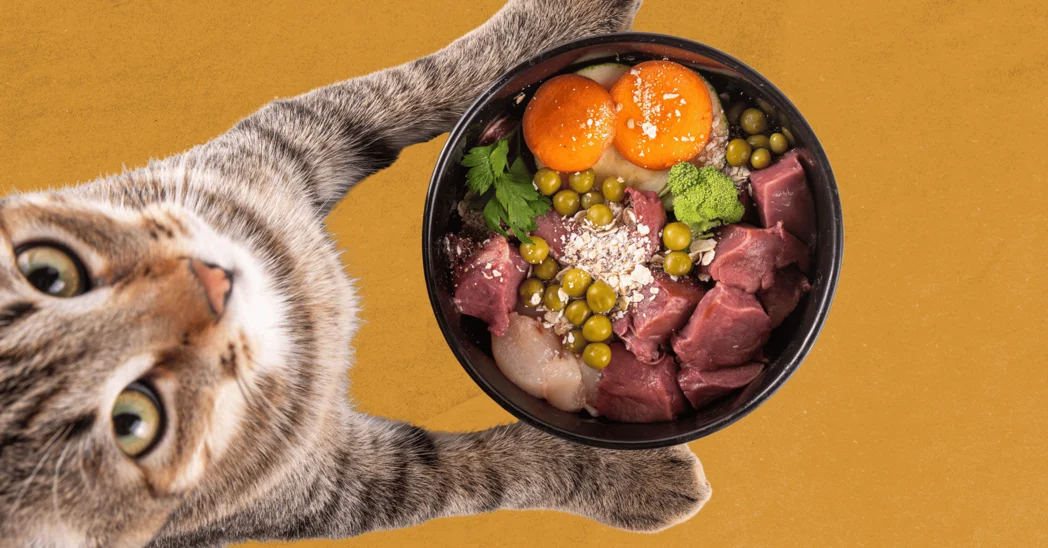
Pet food makers are paying cats and dogs to be food critics. At Mars-owned Royal Canin's center in France, nutritionists weigh which kibble the animals eat first, then track how they behave afterward (and, less glamorously, their stool). Picky palates pay: Americans spent $68.3B on pet food and treats in 2025 – The Hustle.
Amazon revised its engineering guidelines to warn staff against "tokenmaxxing," which means inflating AI usage to look productive – Dealroom.
Seattle startup Endurance Energy tested what it calls the world's first subsea geothermal power plant, a mile under the Pacific off Oregon and powered by an underwater volcano. The test produced only 16.5 kW of net power, and its first commercial target is Tonga – The Hustle.
See you tomorrow,
Katherine Castelán & Jose Kont
The humans behind The Investor Society