
A5X Lands US$70M to End B3's Monopoly on Brazilian Derivatives
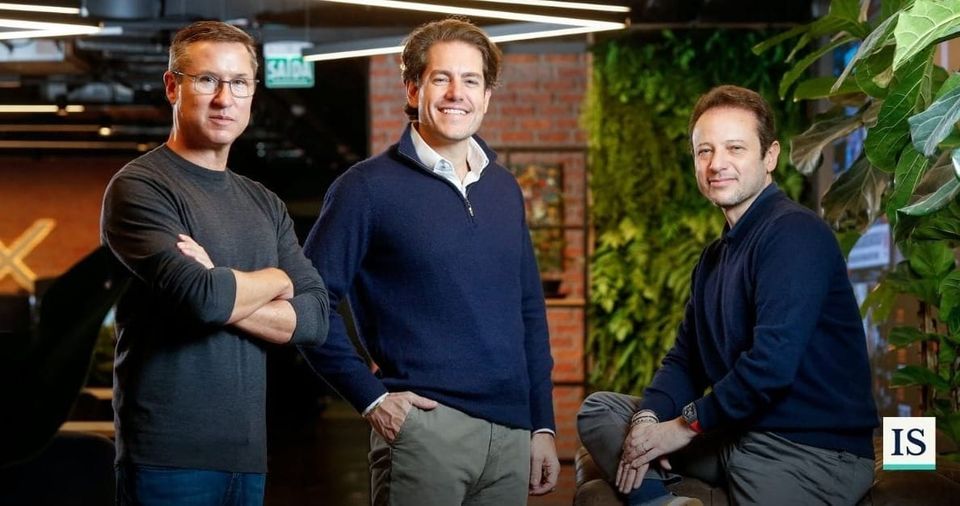
A5X, the Brazilian startup building a derivatives exchange to compete with B3, said on September 14, 2026 that it had raised about US$70 million (R$360 million) in a Series D round at a post-money valuation of roughly US$525 million (R$2.7 billion). Morgan Stanley, Goldman Sachs and the Latin American venture fund Kaszek came in as new investors, alongside existing backers including the market makers IMC, Jump Trading, Optiver and XTX Markets, plus ABN AMRO Clearing. The broker XP exercised a purchase option in the round, and Itaú's brokerage arm has been an investor since 2024. The company has now raised more than US$143 million (R$730 million) across four rounds since it was founded in 2023.
A5X was created by Chief Executive Officer Carlos Ferreira Filho and co-founders Karel Luketic, both former XP executives, Nilson Monteiro, who built the Link brokerage and later founded Ideal, sold to Itaú in 2022, and the capital markets attorney Julian Chediak. The company plans to list futures and options on stock indices, single stocks, currencies, interest rates and crypto assets, running its own central counterparty rather than clearing through B3, with technology supplied under an agreement with the London Stock Exchange Group. The round came with a slipped timeline: A5X now expects to open for trading in the second quarter of 2027, against earlier guidance of late 2026, with regulator connection testing scheduled for October and November of this year. Authorization from Brazil's securities commission and the central bank is still pending.
Market Context
B3 has been the only game in Brazilian listed markets for more than a decade, and the part A5X is attacking is the part that pays. In a note cited by Money Times, Goldman Sachs estimated that listed products accounted for 32% of B3's revenue in 2023, split between roughly 8% from equities and 24% from fixed income, currencies and commodities contracts. That revenue line grew at a 16% compound annual rate between 2016 and 2023, but average fees per contract fell about 4% a year over the same period, which is the trend a challenger tends to accelerate.
Goldman also flagged the limit of the threat, arguing that A5X would need to create its own contracts rather than replicate B3's to move the needle, and kept a neutral rating on the incumbent partly because competitive risk was already reflected in the stock's discount. The competitive pressure is not coming from one direction either: Base Exchange has been pursuing a similar opening. What makes this round different from the earlier ones is the identity of the money. Morgan Stanley and Goldman Sachs are not just financing a new venue, they are potential users of it, which is the same playbook that launched Members Exchange in the United States and BATS before it.
What Stands Out
"Competition is expected to foster innovation and technology advancement, and lead to better pricing." — Karel Luketic, Co-Founder, A5X
Regional Relevance
For the United States, this is an export of market structure. American equity and derivatives trading has been multi-venue for two decades, and the firms that learned to profit from fragmentation, high-frequency market makers and clearing banks, are precisely the ones funding A5X. Jump Trading, Optiver, XTX Markets and ABN AMRO Clearing all stand to gain from a second Brazilian venue that prices aggressively to win volume. For Morgan Stanley and Goldman Sachs, the investment is both a return bet and a hedge on execution costs in one of the largest emerging-market derivatives pools.
For Brazil, the stakes sit in the cost of hedging. B3's dollar and interest rate futures are the instruments through which Brazilian companies, banks and foreign investors manage currency and rate exposure, and every basis point of fee shows up in the cost of doing business. A credible second venue would pressure those fees, but it also splits liquidity, and liquidity is what makes a derivatives contract usable in the first place. Regulators have to decide whether two central counterparties in a market this size strengthens the system or fragments the collateral behind it.
The delay matters as much as the money. Pushing the launch from late 2026 to the second quarter of 2027 hands B3 another two to three quarters to sharpen pricing and lock in clients before the first competing contract trades.
The Other Side
Does a challenger exchange work without its own contracts? Goldman's argument is that copying B3's contracts is not enough, because open interest and margin offsets live where the liquidity already is. A5X's answer is its own clearinghouse, which in theory lets it compete on the full cost of a trade rather than the execution fee alone. That only works if enough participants move collateral to a venue with no history.
Is the delay a red flag or a discipline? Two to three quarters of slippage in a business awaiting two regulators is not unusual, and the company says its systems are ready. But every quarter of delay burns capital before a single contract clears, and the previous round was sized to reach break-even within six to twelve months of launch, a milestone now pushed into 2028.
What happens if B3 simply cuts prices? The incumbent has been lowering average contract rates for years and has the margin to go further. A fee war before A5X opens would compress the very spread A5X is raising money to capture, and B3 would still own the installed base.
Sources & Transparency
- The A5X Funding Round Raised About US$70 Million to Challenge B3 in Derivatives, Not Equities
- A5X, a nova bolsa de derivativos e futuros, se diz pronta para operar
- A5X, nova bolsa brasileira de derivativos, capta R$ 360 milhões com gigantes do mercado — e já tem data para estrear as negociações
- Brazil derivatives exchange A5X to launch in 2026 with $73 million backing
- B3 (B3SA3): What is the impact of the new stock exchange on the company, according to Goldman Sachs
- A5X capta R$ 360 milhões em rodada Série D e avalia empresa em R$ 2,7 bi